





Contents:
- Unpacking What “Natural Volume and Bounce” Actually Means
- A Brief History of Curly Extensions in the UK Market
- Common Misconceptions About Curly Hair Extensions
- How London Weather and Humidity Affect Curly Extensions
- A Brief History of Curly Extensions in the UK Market
- Curl Pattern Matching: The Technical Core of a Good Result
- Why Mismatched Curl Patterns Are So Noticeable
- Volume Distribution and the Weight Problem
- Attachment Methods Best Suited to Curly Textures
- Human Hair Versus Synthetic Curly Extensions
- A Sustainability Angle Worth Considering
- Expert Insight on Getting Curly Extensions Right
- Practical Application: Wearing and Maintaining Curly Extensions
- Washing Routine
- Detangling Without Losing Shape
- Refreshing Curls Between Washes
- Sleeping to Protect Curl Pattern
- Choosing the Right Products
- Scheduling Move-Up Appointments
- Choosing a Provider for Curly Hair Extensions London
- Frequently Asked Questions
- Do curly hair extensions require different aftercare than straight ones?
- How is curl pattern matched to my natural hair?
- How long do curly hair extensions last?
- Are curly extensions more expensive than straight ones?
- Can curly extensions be straightened if I want a different look occasionally?
Steam rises gently from a heated styling wand as a technician separates a small curl, twirls it once around her finger, and releases it to spring back into a perfect, glossy coil. The scent of argan oil hangs in the air, mixed with the faint metallic note of the copper rings used to secure each section. This is what a well-run curly extension fitting looks and feels like, and it is a world away from the flat, lifeless “curly” extensions that gave the category a poor reputation for much of the last decade.
Curly hair extensions in London have gone through a genuine transformation over the past few years, moving from a narrow, one-size-fits-most product into a category built around precise curl matching, proper volume distribution and techniques suited to how curls actually behave when wet, dry, brushed or left to air-dry. Understanding what separates a convincing curly set from a disappointing one requires unpacking several layers: the history of the category, the mechanics of curl and volume, and the practical realities of wearing and maintaining curly extensions day to day.
Unpacking What “Natural Volume and Bounce” Actually Means
Volume and bounce sound like marketing language until they are broken down into their physical components. Volume refers to the amount of visible space hair occupies relative to the head — a function of strand thickness, density, and how much the hair lifts at the root. Bounce refers to how a curl responds to movement: whether it springs back into shape after being stretched, or simply hangs limp until reshaped with heat.
Both properties depend heavily on curl pattern, typically classified on a scale from 2A (loose waves) through 3A to 3C (defined, springy curls) to 4A through 4C (tighter, coilier textures). Extensions marketed simply as “curly,” without reference to this scale, are almost always calibrated to a single midpoint — usually somewhere around 3A to 3B — which explains why so many buyers with tighter natural curl patterns have historically found generic curly extensions a poor match.
These two properties are also measurable, at least approximately, which is useful when comparing providers or products rather than relying purely on visual impression. Volume can be estimated by gram weight per section relative to head circumference, while bounce can be tested by stretching a single curl to roughly one and a half times its resting length and observing how quickly and fully it springs back once released — a curl that returns to its original shape within a second or two indicates strong, well-preserved structure, while a slow, incomplete recovery suggests the curl pattern has already begun to relax, whether from age, heat damage, or poor initial processing.
A Brief History of Curly Extensions in the UK Market
Ten years ago, curly hair extensions available in most UK salons were essentially straight hair given a loose, temporary wave using a curling iron before sale. The wave dropped out within a few washes, since it had never been part of the hair’s natural structure, leaving buyers with what was effectively straight hair marketed under a curly label.
The shift toward genuinely curl-pattern-matched extensions began as demand grew from a wider range of natural hair textures represented among London’s population, alongside growing awareness that a one-size approach was failing a large proportion of potential clients. Suppliers began sourcing donor hair that was naturally curly rather than artificially waved, and grading it by curl diameter rather than a single vague “curly” tag. This is the standard that specialist providers, including Ivana Farisei, now build their entire curly extension range around, rather than treating it as an afterthought to a primarily straight-hair-focused business.
Part of this shift also reflects a broader change in how the wider beauty industry talks about curl. A decade ago, marketing materials for extensions rarely showed genuinely tight curl patterns at all, defaulting instead to loose, straight-hair-adjacent waves regardless of what “curly” was supposed to represent. As demand and representation grew, so did the technical vocabulary — curl diameter, shrinkage percentage, coil consistency — giving both buyers and technicians a far more precise shared language than the single word “curly” ever provided.
Common Misconceptions About Curly Hair Extensions
A handful of persistent misconceptions still circulate, often repeated by providers that have not invested in genuine curly-specific training. The first is the assumption that any curly-textured hair will suit any curly-haired client, when in practice a mismatch of even one or two steps on the curl diameter scale is immediately visible once installed. The second is the belief that curly extensions require dramatically more product than straight ones; in reality, they require different products — heavier on hydration, lighter on silicone — rather than simply more of everything.
A third misconception, unfortunately still common among less experienced providers, is that curly extensions can be sectioned and attached using exactly the same grid pattern used for straight hair, then “corrected” afterwards with a diffuser or curling wand. This approach routinely produces the uneven, patchy root line described earlier, since it ignores how curl naturally clusters and falls once the tension of application is released.
How London Weather and Humidity Affect Curly Extensions
London’s climate presents a specific challenge for curly hair that drier climates do not: frequent, unpredictable humidity swings across the year, particularly in the milder, damper months of autumn and early spring. Humidity causes hair to absorb moisture from the air, which can cause looser curl patterns to drop or frizz if the cuticle is not adequately sealed, whether on natural hair or extensions.
Single-donor, cuticle-intact curly hair handles this considerably better than processed or non-remy alternatives, since an intact cuticle layer resists moisture absorption far more effectively than hair that has been chemically stripped and re-coated with silicone. This is one of the more practical, day-to-day reasons that hair grade matters even more for curly extensions in a city like London than it might in a consistently drier climate.
A Brief History of Curly Extensions in the UK Market
Curl Pattern Matching: The Technical Core of a Good Result
Matching curl pattern is not simply a matter of picking “tight,” “medium” or “loose” from a short list. Curl diameter, the tightness of the spiral measured in millimetres, needs to correspond closely to the client’s own hair, and so does the curl’s overall shape — some curls form a consistent spiral throughout the strand, while others coil more tightly near the root and loosen slightly toward the ends.
Curly hair extensions london buyers increasingly expect this level of precision, and Ivana Farisei sorts its curly range by measured curl diameter rather than a generic label, checking each client’s natural curl against physical samples during consultation rather than relying on a photograph or verbal description. This step alone accounts for much of the difference between a curly set that blends invisibly and one that creates an obvious, two-textured look once the extensions are in place.
Why Mismatched Curl Patterns Are So Noticeable
A curl pattern mismatch is far more visible than a simple colour mismatch, because curls interact with light and movement in ways that straight hair does not. A section of tighter curl sitting next to a section of looser curl creates an uneven silhouette that is obvious from a distance, even if the colour match is close to perfect. This is one of the most common complaints among buyers who purchase curly extensions without a proper in-person consultation, ordering online based on a product photo rather than a genuine curl-diameter assessment.
Volume Distribution and the Weight Problem
Curly hair, strand for strand, tends to occupy considerably more visual space than straight hair of the same weight, since each curl adds width without adding length in a straight line. This means a full head of curly extensions can look proportionally larger than an equivalent set of straight extensions using the same gram weight — a detail that surprises many first-time buyers who assume volume scales identically across textures.
Getting the distribution right also means paying close attention to where volume sits. Concentrating too much weight at the crown, without matching density further down, creates an unnatural, top-heavy silhouette. A well-planned curly set builds volume gradually from the mid-lengths downward, mimicking how natural curl density typically increases slightly toward the ends rather than sitting uniformly across the whole head.
Attachment Methods Best Suited to Curly Textures
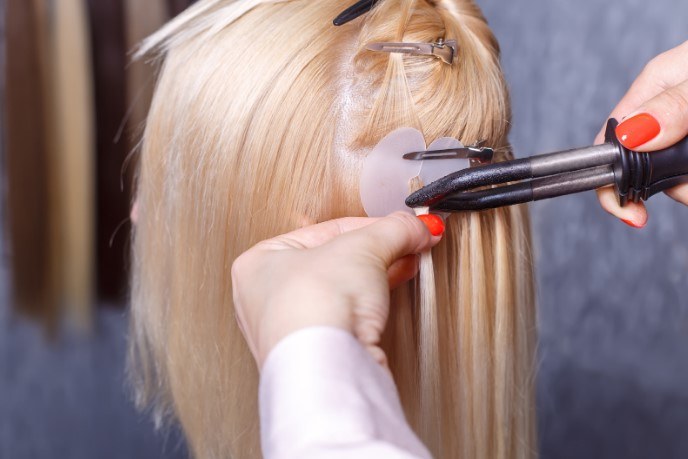
Not every attachment method handles curly hair equally well. Micro ring and nano-bead methods tend to perform best, since the small, evenly spaced attachment points can be positioned along the natural curl pattern rather than forcing hair into an artificial straight-line sectioning grid. Tape-ins can work for looser curl patterns but often create visible flat patches where the adhesive strip sits, since the tape itself has no curl and disrupts the otherwise consistent spiral shape around it.
Sectioning technique matters as much as the method chosen. Technicians experienced with curly hair section while the curl is in its natural, undisturbed state, checking how each piece will sit once released rather than only while the hair is stretched taut during application. This is a noticeably slower process — often adding thirty to forty minutes to a full-head fitting compared with straight hair — but it is the detail that prevents the uneven, mismatched root line that gives away a poorly executed curly set.
Human Hair Versus Synthetic Curly Extensions
Synthetic curly extensions hold their shape well immediately after purchase, since the curl is heat-set into the fibre during manufacturing, but that same heat-set curl cannot be restyled — expose synthetic fibre to a straightener or curling wand and it typically melts or frizzes irreparably. This makes synthetic curly extensions a reasonable choice for a single event or short-term wear, but a poor fit for anyone wanting to style their hair flexibly over several months.
Human hair curly extensions, by contrast, behave like natural hair: they can be reshaped with heat, respond to styling products the same way natural curls do, and age more gracefully, gradually loosening rather than melting or frizzing irreversibly. For semi-permanent, bonded methods worn for months at a time, human hair is the only sensible option, which is why every specialist provider offering genuinely long-term curly extensions, Ivana Farisei included, works exclusively with human hair for bonded applications.
A Sustainability Angle Worth Considering
Curly hair extensions raise a sustainability question that straight extensions largely avoid: because curl-pattern-matched donor hair is rarer and more time-consuming to source and grade, a meaningful proportion of curly hair historically went to waste in the wider industry, either discarded during processing or blended down into lower-grade, less traceable products. A more sustainable approach treats curl-pattern hair as a distinct, valuable category from the outset, grading and preserving natural curl rather than chemically stripping and reprocessing it into a generic straight product only to re-curl it artificially later.
Single-donor sourcing also has a knock-on sustainability benefit for the client. Because single-donor, unprocessed curly hair holds its structure and lifespan considerably longer than reprocessed alternatives, it needs replacing less often, which reduces the overall volume of hair extensions a regular wearer gets through in a year. Ivana Farisei’s approach to sourcing curly hair prioritises this kind of single-donor traceability, which supports both a better-blending result and a lower environmental footprint per year of wear compared with cheaper, frequently replaced alternatives.
Expert Insight on Getting Curly Extensions Right
“The single biggest error I see, even among experienced stylists, is treating curl pattern as a cosmetic detail rather than a structural one,” says Priya Ostara, a hairdressing lecturer and extension specialist with fifteen years of experience training technicians across London salons. “Curl diameter determines how hair moves, how it absorbs product, and how it ages over months of wear. Get that wrong at the fitting stage, and no amount of styling afterwards will fully correct it.”
This view lines up closely with how Ivana Farisei approaches curly fittings, treating curl-diameter measurement as a mandatory step rather than an optional add-on for clients who specifically ask for it. Skipping this step to save consultation time is precisely the shortcut that produces the mismatched, unnatural results Ostara describes.
Practical Application: Wearing and Maintaining Curly Extensions
Washing Routine
Curly hair, natural or extension, needs less frequent washing than straight hair, since natural oils take longer to travel down a spiral strand and curls generally look better with some residual product and oil rather than freshly stripped. Washing every four to five days, using a sulphate-free, curl-specific shampoo, keeps both the natural roots and the extensions in good condition without over-drying either.
Detangling Without Losing Shape
Brushing curly extensions with a standard bristle brush breaks up the curl pattern and creates frizz. A wide-tooth comb or fingers, used only on damp hair with a leave-in conditioner or detangling spray applied first, preserves the curl shape far more effectively, starting from the ends and working upward in small sections.
Refreshing Curls Between Washes
A light water and leave-in conditioner mix, scrunched gently into dry curls, revives shape and bounce between wash days without the need for daily heat styling, which gradually loosens curl pattern over repeated use, particularly at the point closest to any bonded attachment.
Sleeping to Protect Curl Pattern
A silk or satin pillowcase, or a loose pineapple-style updo secured at the crown overnight, reduces friction that would otherwise flatten curls and cause tangling around attachment points by morning.
Choosing the Right Products
Curly hair, whether natural or extension, generally responds best to lightweight, water-based leave-in conditioners and curl creams rather than heavy oils applied at the root, which can weigh curls down and, on bonded methods, leave residue around attachment points that gradually loosens the bond. A light mist of curl refresher, applied mid-lengths to ends only, tends to revive shape more effectively than a heavier product applied throughout.
Scheduling Move-Up Appointments
Because curl pattern makes root growth slightly more visible than it would be on straight hair, move-up appointments for curly extensions are generally best scheduled a week or two earlier than the equivalent straight-hair timeline — typically every six to eight weeks rather than eight to ten — to avoid an obvious gap between the natural curl at the root and the extension curl below it.
Choosing a Provider for Curly Hair Extensions London
Given how much curl pattern matching affects the final result, the choice of provider matters more for curly extensions than for almost any other extension category. A specialist offering genuine curl-diameter grading, physical sample matching during consultation, and technicians trained specifically in curly sectioning will consistently outperform a generalist salon treating curly hair as a minor variation on their standard straight-hair process.
Hair extensions london uk clients researching curly-specific providers will find that pricing for a properly matched curly set typically runs £500 to £950 for a full head, reflecting both the rarer donor hair and the additional technician time curly sectioning requires. That premium, in this specific category, buys something concrete rather than simply covering a brand name — a materially better blend and a longer-lasting, more natural-looking result.
Frequently Asked Questions
Do curly hair extensions require different aftercare than straight ones?
Yes — curly extensions generally need less frequent washing, wide-tooth combs or fingers rather than brushes, and curl-specific hydrating products to maintain shape and reduce frizz.
How is curl pattern matched to my natural hair?
A specialist consultation measures curl diameter against physical hair samples, checking the match under salon lighting rather than relying on a photograph, since curl shape and shrinkage vary considerably between patterns.
How long do curly hair extensions last?
Well-matched, properly maintained curly extensions typically last four to six months before a move-up appointment is needed, similar to straight extensions of comparable quality.
Are curly extensions more expensive than straight ones?
Generally yes, often by £50 to £150 for a full head, reflecting the rarer sourcing and additional technician time curl-pattern matching and sectioning require.

Can curly extensions be straightened if I want a different look occasionally?
Human hair curly extensions can usually be temporarily straightened with heat tools, though returning to full curl definition afterwards may require a light re-setting technique, which a specialist technician can advise on during aftercare guidance.
+ There are no comments
Add yours